Sunday, June 15, 2014

Re-enemated

I disappeared for a while.

I disappeared into darkness, anger, and pain.

My second Crohn's flare started simmering in late February. The difference between everyday symptoms and a flare is obvious for me: blood. Losing blood is not an everyday symptom.

What caused this flare? I discourage that question, because the factors at play in this disease are many, tangled, highly individual, and poorly understood. But that said, maybe the inflammation was kicked off when I tried to eat a couple (literally, a couple) well-cooked vegetables that I hadn't eaten in a while. Can you blame me? Regardless, I had no idea after a year of relative health that my condition was so very tenuous. That's scary, that my health can plummet so immediately.

I firmly believe everyone with Crohn's should have this towel next to their toilet.
(Ten points to you if you get the reference.)
March kicked off what would become a grueling months-long trial full of attempts to cage my poor deranged immune system. Gastroenterologists, blood tests, stool tests, steroids, more of this medication, less of that medication, complication after complication. Nightly steroid enemas, anal fissure ointment, a colonoscopy to boot.

The steroids that were my savior during my first flare didn't work this time. I was on a high dose for far longer this year, long enough to suffer not only from the cosmetic side effects (unfortunate hair growth, raging acne, weight gain, hello) but also from the mental side effects: confusion, anxiety, depression, outrageous mood swings. And when my knees swelled up without warning one Monday, I felt like giving up completely. (No one wants to hear, when they see you on crutches, that it's a medication side effect. They'd rather hear that you slipped on a banana peel while vacuuming. Alas.)

Crutches: more exercise than one would think.
Exhaustion: deep, consuming, just-climbed-a-mountain exhaustion. Agony: Alien-attempting-to-burst-through-my-abdomen agony. Fear: blinding, fiery, imminent-destruction fear. And guilt, when the best option was to ramp up to the next "tier" of medication, one that involves me injecting myself with two needles every month.

It's a big, scary syringe with a cute name.
Despite all this, I was mostly okay for the first five or six weeks of this flare. I'd been through one before and knew I could survive it, that life would get better eventually. But I couldn't maintain my positive outlook. I got overwhelmed. Hope is crucial for making it through the darkness; the pain hid hope behind a locked door and I saw it happening but didn't stop it. I started snapping at the people who asked me how I was doing, sobbing the moment I was alone. There were moments of lightness, like when I spent a few hours brainstorming hilarious enema puns ("Sleeping with the Enema," anyone?). For the most part, though, three months of my life disappeared into a void.

Enema, dressed in white! Doesn't it look like one of those bottles used to feed baby farm animals? No?
I'm about back to how I felt pre-flare, which is still not great, but it's glorious not to be in pain all the time and to be off the worst of the steroids. The injectable medication seems to be having some effect. I wish I had some deeper insight to give upon looking back at this year so far, but I'm still in a bit of daze. However, there are a few small realizations (pieces of advice for someone going through a similar situation?) I can offer:

1. You are loved. People want to help you. Let them help. Appreciate them.
2. Try to find those little bright spots to sustain you until you can see the light again.
3. Reevaluate how you will spend the healthy days.

I'm so grateful to everyone who offered me a kind word or a loving embrace. There are a few voices and warm hands that I can credit for carrying me and helping me break down the door behind which hope lay in wait. There really is so much beauty in the world. I don't want to forget that again.

Sunday, April 6, 2014

Vocalizing IBD

So I'm in the midst of my second real Crohn's flare. And I insist on talking about it. Not because I like complaining; to the contrary, my instinct is usually to huddle in a corner or crawl under a blanket and hope no one approaches. But after the shock and emotional upheaval of my first flare at the end of 2012, I decided to be as vocal as possible about this disease. There are three reasons for this:

1. A chronic illness is not something any person should have to endure in stoic silence. Often, those with a chronic illness (especially an "invisible" one) feel a responsibility to avoid burdening the people close to them. But that's just absurd. Being able to confide in people, utilize what assistance they offer, and take comfort from their closeness is, in some cases, the only medicine that can help.

2. The inflammatory bowel diseases are uniquely troublesome because of the very taboo nature of many of the symptoms. No one wants to hear about them. No one wants to talk about them. It can cause a profound, deep-rooted type of shame to lose control over your bodily functions.
Nothing says "close" like Twister.
Of course, this was back when I wasn't in too much pain to Twist.
If others don't understand just how much and in how many ways the life of someone with IBD is impacted, they can unwittingly amplify that shame. "Why can't you go out to eat with us? Shouldn't you be taking care of yourself better by [insert simplistic holistic/nutritional remedy here]? Are you just being dramatic when you double over in pain in the middle of the street, when you're moaning and crying in that bathroom stall? How can you do your work if you always have to run out of meetings halfway through? Can't you control that gas? Do you really have to pull over on the side of the road again?" If you're someone trying to deal with IBD, the very last thing you need is to feel ashamed and guilty about the symptoms. You need understanding and compassion.

I have a robust medicine cabinet. Hoping hard that something will kick in soon.
3. I want people to pay attention to their own bodies. An astounding number of people with IBD are misdiagnosed for many years or are only given any diagnosis once they land in the hospital for emergency surgery. But if more people are a) aware of the symptoms and b) not too ashamed to talk about them and seek help, more people can have a hope of getting earlier treatment and postponing some of the worst complications of these diseases.

And yet, in this post, I've been rather vague. So I'll get graphic here in the interest of IBD awareness.

You might experience:

  • Stomach cramping, especially during or just after meals and during bowel movements, ranging from barely perceptible to agonizing
  • Localized chronic pain at the rectum, anus, or specific parts of the abdomen
  • Increased bowel movement frequency and changes in stool consistency and color
  • Prolonged bouts of diarrhea
  • Mucus in stool
  • Bloody bowel movements, ranging from dots on toilet paper and streaks in the stool to crimson toilet water
  • Nausea
  • Gas and bloating
  • Weight loss
  • Loss of appetite
  • Fatigue
  • Joint pain
  • Eye problems
  • Changes in mood and personality

And a host of complications I won't go into. So please, be caring and kind. And please pay attention to your own digestive health.

Sunday, March 16, 2014

Easy Baker: Better Oatmeal Bars

January 2024 update: 

Please note that many posts in this blog are a record of a person with multiple eating disorders who sought questionable care, was excited about dangerous lifestyle choices, and believed in achieving absolute health through eating (which is something that cannot be done and is often more detrimental to one's overall health).

I do not recommend following any posted advice or using the person I was in these posts as an example for anything related to food. If you're experiencing issues related to food and feel yourself in the grip of diet culture, I suggest seeking care from a counselor who focuses on eating disorders and, in the meantime, gently challenging preconceived notions of health and wellness through your media choices. A favorite of mine and a pillar of my treatment these days is the podcast Maintenance Phase.
-----------------------------------------------
Original post:

All right. Here I am, baker extraordinaire, for an encore of my single crowning achievement, the easy homemade oatmeal protein bars. To be honest, this revised recipe is much tastier than the original (and it's rather simpler to boot).

These bars are quick and nutritious and oh-so-gentle for most digestive tracts. They're the ideal flare food for me (Crohn's flare, that is...more on that in a later post) and acceptable for a whole host of dietary restrictions that you might happen to be saddled with. Furthermore, they're cheaper and less processed than many bars you'd find in the store, and they're perfect for breakfast, snacks, energy boosts between or after workouts, even dessert. They're a bit like cookies.

Seven keys to snack happiness.
Ingredients (makes 6 servings):
  • 1-1/2 cups rolled oats
  • 3 ripe bananas
  • 2 Tbsp. vegan protein powder (any kind of protein powder here)
  • 4 Tbsp. almond butter (allergic to nuts? Try an extra banana)
  • 1 Tbsp. cacao powder (I'd say "optional," but...chocolate!)
  • 2 Tbsp. non-dairy chocolate chips (also technically optional)
  • 1/2 tsp. cinnamon
  • (optional) nuts, seeds, dried fruit
Mmm, gooey.
  1. Use a masher or sturdy spoon to mash the bananas. 
  2. Mix in the almond butter.
  3. Pour the powders into the bowl and mix gently.
  4. Mix in the rolled oats and chocolate chips (and any other additions). Depending on the size of the bananas, you may need more oats than the recipe specifies. There should be no uncoated oats, but the mixture need not be too dense; it can be a little bit gooey.
  5. Line a glass baking dish with parchment paper, then pour the ingredient mixture in an even layer onto the paper. The thicker the layer, the longer the baking time.
  6. Bake at 375 degrees for about 50-70 minutes. Why the wide range? I swear it takes a different amount of time each batch. The key is that the edges should be a deep brown and the middle should be golden brown and pliable but neither mushy nor crisp. This is the "trial and error" part of baking.
  7. Cut into as many bars as you want. My rule of thumb is that each banana used yields two bars.
Individually portioned for convenience. Like Lunchables. Except not horrible.
Cut into six sections, my recipe yields bars that are about 230 calories with 8 grams of protein. (Not bodybuilder food by any means, but one of the gentlest sources of protein I've tried. You can tremendously up the protein by adding nuts or seeds or using a higher-protein powder.) I individually wrap each portion, and they're ready to go!

Be advised: they last about half a week before getting too stale. Also, the flavor is pretty mild. In my humble, unbiased opinion, this is (still) a great recipe to alter per your own whims to stay energized and healthy on a budget.

Tuesday, December 31, 2013

Holistic Hell

January 2024 update: 

This post largely holds up, but it includes a reference to a medication that I believed was "about 100% better for you than antidepressants." Not only did this medication not particularly work for me, but the FNP who prescribed it turned out to be almost as harmful in the long term for my overall mental and physical health as the "clinical nutritionist interested in holistic healing," who my providers of the past several years have been horrified by.

Today I would never dream of implying that someone should avoid antidepressants if they need them. Antidepressants are truly life-saving. 

-----------------------------------------------
Original post:

A new year is upon us, so I thought I should tell the other half of the story I started in my last post. That way this one will live in the 2013 archives (of the blog and of my memory) where it belongs.

So there I was, feeling tortured by food, feeling orthorexic (that is, paralyzed by an obsession with "healthy" eating). I found a local clinical nutritionist interested in holistic healing. She doubles as a therapist—exactly what I wanted! She agreed to meet with me.

What I was hoping for was a diet that worked and help escaping the mental prison I kept building myself into. Unfortunately, though, it's apparently not possible to separate me from my Crohn's disease when prescribing an ideal healing diet. It seems obvious, I know. But it meant that little of the time in our meetings over the next several months was spent sorting through mental issues.

Blood tests. Thousands of dollars in supplements. Diet change after diet change after diet change. And it turns out that orthorexia is a nasty issue to deal with when people are trying to heal you through diet. My nutritionist tried to tell me that there's no such thing as perfect eating, that her recommendations were guidelines and not strict rules, that my Crohn's symptoms were not my fault. But accepting that you have the power to heal your disease through diet necessitates accepting that you have the power to worsen it through diet as well. Crippling perfectionism: up a notch.

Indulging in a strawberry on Easter. Gorgeous.
I stuck with it as long as I did because I felt like I'd be failing myself otherwise. Despite researchers' current official stance that diet, though it can worsen symptoms, does not worsen the disease—it is, after all, an autoimmune disease and affects more than just the digestive tract—mountains of anecdotes tell a different story, that so-and-so was "healed" by juicing or being gluten-free or being vegan or eating SCD or GAPS or low-FODMAPs. One of the worst things about having a disease like this one is that just about everyone around you will insist that you can cure yourself if you only did SOMETHING ELSE.

After my time ran out with the nutritionist, I decided I was too deep in debt and too destroyed emotionally for it to be worth continuing. I started seeing a local FNP, and she prescribed an opiate-blocker that essentially prompts the body to pump out extra endorphins (the idea being that endorphins have an effect on immune system function). I felt a little better physically, and probably fifty times happier, taking it. Fortunately it's about 100% better for you than antidepressants. And in terms of diet, she recommended slowly adding things back into my diet and seeing what causes a reaction.

Unrelated cat picture to lighten the mood.
Trusting my own body? A completely foreign concept. My body gets confused and attacks itself. What the heck does it know? But I broke down in tears, as I do every time people try to make me talk about food, at the idea that I can maybe heal something in myself by not following a strict prescribed regimen.

This (along with the aforementioned opiate-blocker and another supplement that immensely reduces my anxiety) is the most valuable thing I gleaned from the trials of the past several months. When my nutritionist was in therapist mode, she pointed out what seems to be the core of my mental issues.

Elementary school vocabulary. My drawing has not improved.
I'm a dictator in my own head. I can't relax until everything on my list is done, and done perfectly. The list is never finished. Nothing is ever perfect, least of all food. I will never be healed in any aspect until I can release some control. "Get a B" is what she said. At the time, the sentence struck chills down my back, and my stomach seized up in revolt.  Now I use it as a guiding principle. 

My mom's farm is a peaceful place. Can I live in this photo, please?
I'm not healed yet.

Sunday, November 24, 2013

Orthorexia

It's hard to give myself a break when the burden of my health always weighs so heavily on my mind. Even when I'm feeling pretty much okay, I could feel better, and I need to do everything in my power to avoid feeling worse. These are the thoughts that have driven me for the past few months. They have not been a pleasant few months.

In early May, I realized that my relationship with food was getting downright dangerous. I had this cycle going since just after getting diagnosed with Crohn's: eat super healthfully (whatever that meant to me at the time) for a couple months; go on a wild, uncontrollable binge-eating spree for a few days; plunge back into eating healthfully with renewed vigor. I knew this was not a healthy cycle. What I really wanted was to achieve that healthy eating ideal 100% of the time. (I wrote about this before, and you can read the shame I've felt for so long.)

That is also not healthy.

But, see, my mind latches onto health-related information and does not let it go even when the information and the advice it spawns are in direct conflict with other advice I've accepted as law. (There's a relevant little story that went around not too long ago that describes the phenomenon: "The Terrible Tragedy of the Healthy Eater.") And furthermore, I'm a perfectionist. If there's a way to "do it right," you'd better believe I will do whatever I possibly can to "do it right." I will drive myself to destruction to do it right.

Did you know I got straight A's for 11 consecutive years?
I'm not bragging. I now actually think it's a bad thing.
What's not a bad thing is that "SAVE FERRIS" pin. Good job, me.
My point is that, driven by both external information and obsessive perfectionist internal dialogue, what I ate when I was eating "healthy" gradually got whittled down to fewer and fewer choices. My palate was not satisfied, my food addictions were not quelled, I was constantly berating myself. It was evidence of a profound distrust of my body (having an autoimmune disease can do that), a complete lack of faith that it would tell me what was right for me, and a growing hatred of food.

Here's me in April again, before my first 5K. Do you wonder what "Clean 13" means?
It was a self-inflicted challenge to eat nothing but produce and 13 other "clean" food items
(dark chocolate, salmon, rice, etc.) for 13 straight weeks.
I made it about a month. The whole thing was a really, really bad idea.
It got to the point where I was thinking about food all day long, stewing in a cauldron of frustration and negativity, and yet I did not want to eat at all anymore. I've never gotten to the point where I actually did stop eating; instead, I binged ever more frequently on the aforementioned food addictions because they were the only food items that brought me any degree of pleasure. So I hated food, I gained weight, I was angry all the time. At that point I found a clinical nutritionist and therapist (all in one person! What luck!) and reached out to her. I wanted someone to help me sort through the mental issues and tell me what I should be eating.

That's not precisely what ended up happening.

To be continued...

But for now, the moral of the story is that extremes of any sort can be a form of abuse to your body. Good intentions can go awry.

Sunday, September 1, 2013

The Great Adductor Strain

We all "know" what we're "supposed" to do to take care of ourselves. When we exercise often, a few more tasks are added onto the to-do list of self-care. And I suspect that, like me, most people aren't as vigilant about these tasks as they are about the actual workout.

You should be.

Ah, the good old days of hearty, healthy adductors. Last year.
I strained both my adductors (inner thighs) at the end of January, and not until seven months later did my legs start to feel mostly normal. About 80% normal. So, without further ado, here's what I learned from the Great Adductor Strain of 2013:

Don't do too much too soon. The Strain happened a few weeks after I began teaching six Zumba classes a week. Not a lot for some, but a lot for me. And there were even a couple weeks when I taught eight. If you're doing a level of activity that's elevated way beyond your norm, be careful.  

Stretch. I was so tired the week prior to The Strain that I decided to forgo my usual nightly stretching routine to go to bed a few minutes earlier. Mistake.

Warm up. The Strain happened on a day when I was following someone else's routines without really warming up first. I tend to lay the blame on the "samba lunges," but the truth is that I should've warmed myself up.

Pay attention to your body. Maybe, if you injure yourself, you'll fall down and clutch something in pain. Or maybe you won't even notice until hours later, as in my case. I just felt a strong general ache. I assumed it would either fade after a few days or remain for months as a muscle injury. At that point, my thinking was, well, not much I can do about it now. False.

Allow yourself to recuperate. So... instead of resting, I just kept teaching. I did light squats and told everyone else to get deeper. This was painful in more ways than one; I love to squat. I literally almost passed out when I did a hip circle at the beginning of a class.

And then, two weeks later, was the Zumba Instructor Conference. I moved as little as possible while there, but I couldn't avoid the miles of walking and hours of standing and (very light, in my case) dancing. Since The Strain, I've never really gotten the chance to rest my aching thighs for more than a few days total.

Trust me, I would've been in a much goofier position if I'd had fully functional legs.
Take action to heal. In many cases, rest and extra stretching just won't cut it. I waited several weeks before my bizarrely cracking hips made me go to the chiropractor, who finally confirmed my suspected self-diagnosis of strained adductors. She dug her fingers into the "spasm" in my poor tender flesh and messed around in there, agonizingly. After that, I could walk so much more easily.

But it wasn't enough. I needed painful massage after painful massage with more than one massage therapist. I needed "reciprocal inhibition" to try to force my locked-up muscles to relax. I needed hot baths and long walks and foam rolling and endless stretching. If I hadn't waited weeks between injury and diagnosis, between one appointment and the next, I could've healed much faster.

Moral of the story? Take care of yourself, or you could cause yourself serious, lasting injury. You might not be able to squat for months, and that would be awful.

Because squatting is fun.

Saturday, June 22, 2013

Retrospective

So here I am, startled to discover that it's already summer. The past few months have been punctuated by more than one major achievement for me, and considering how I rarely take time to celebrate such achievements, I think they might be due some acknowledgment.

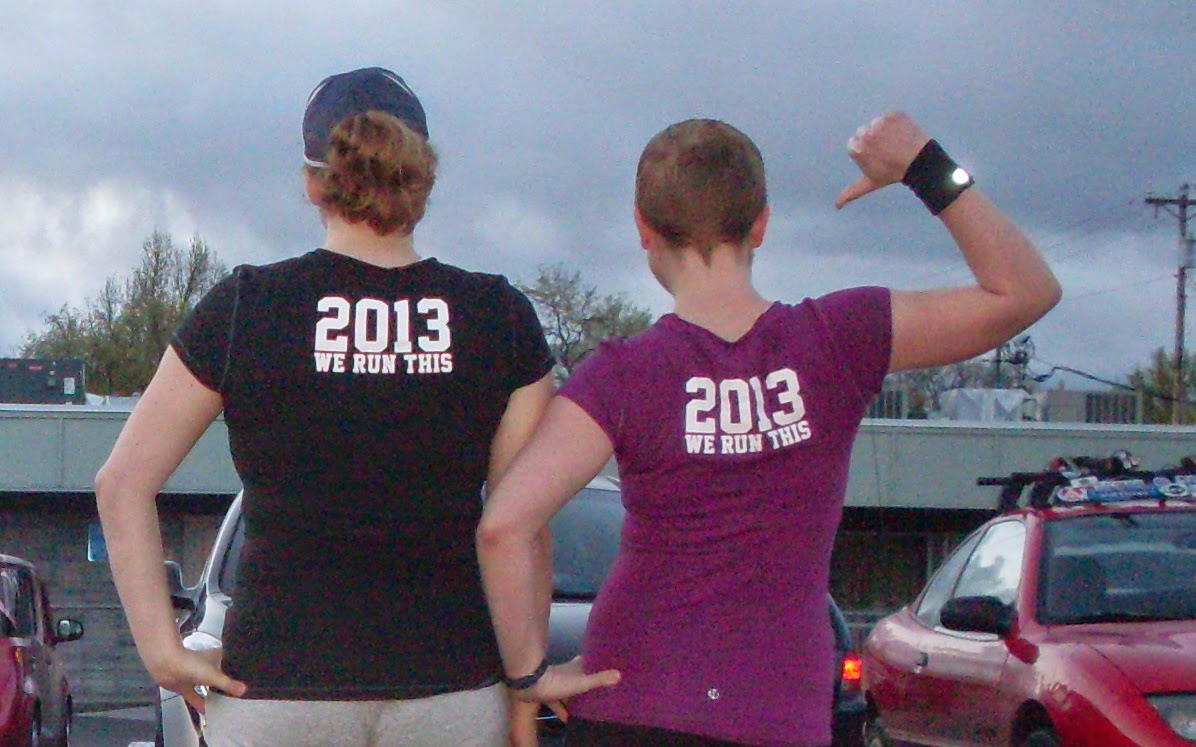
I ran my first race. A 5K, in a respectable 30:29. Surprisingly, I felt great, despite the inner thigh strain that hasn't quit hurting even five months later. The atmosphere at the starting line was electric. The unity and camaraderie I felt with a couple thousand strangers was exhilarating. The mutual appreciation for accomplishment displayed when the first speedy runners passed us already heading back to the finish line, when we applauded and cheered though we scarcely had the breath to spare to do so, was deeply touching. Remember paroxysms of joy? Like that.

2013: We run this. It was a perfect day for our first race.
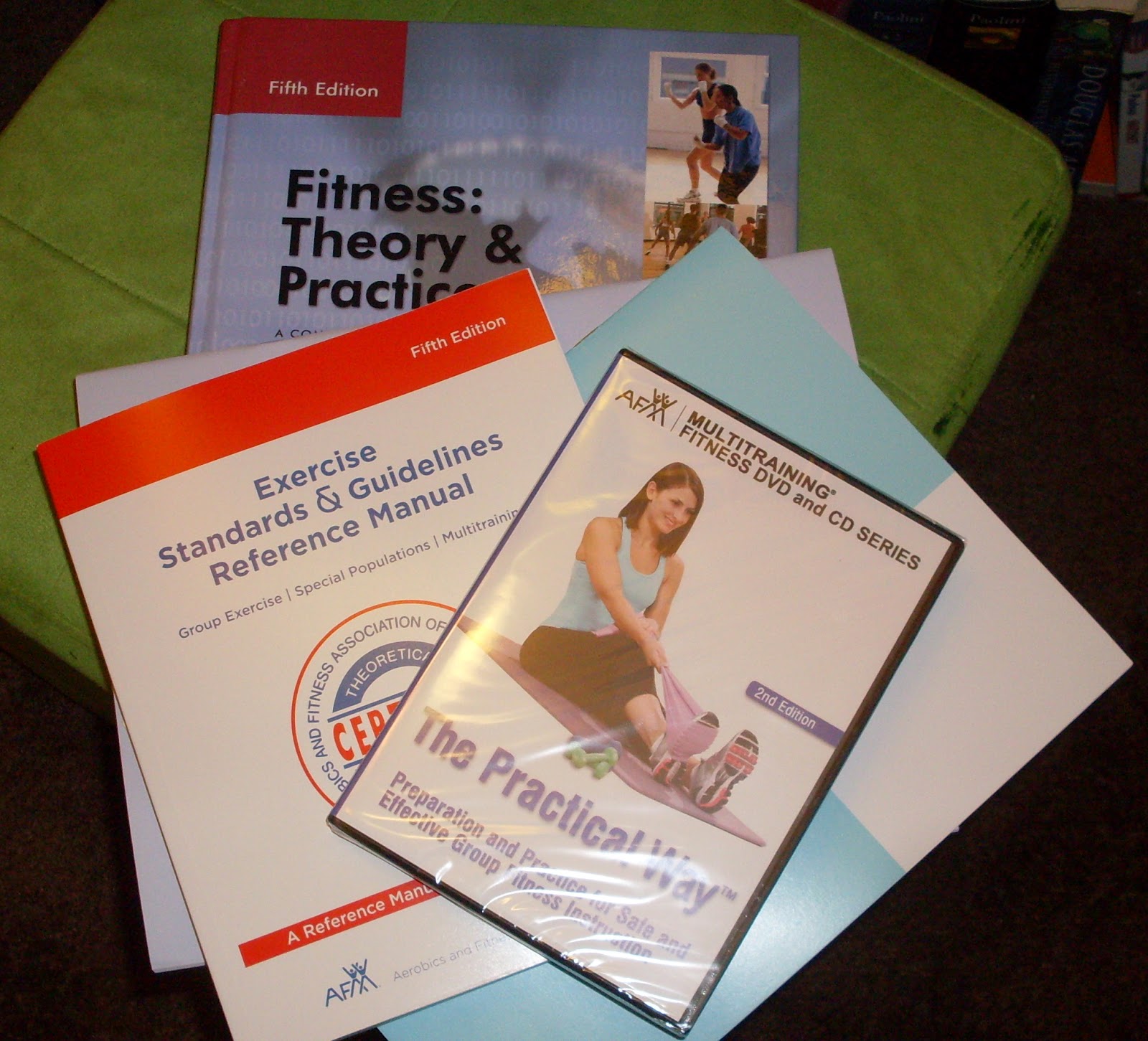
Two weeks later was my Aerobics & Fitness Association of America (AFAA) Group Exercise Instructor Certification. In the midst of everything else I'd been doing all spring, I made time to read a chapter or two of that massive textbook every night, all in the hopes of being a better and safer instructor for the people who place their well-being in my jingling hands. When my workshop and testing was cancelled, I immediately booked another in California and drove down after work on a Friday. Not that I learned this until a month later, but I passed easily. Just about one year to the day after getting licensed as a Zumba instructor.

The many AFAA textbooks, study materials, and DVDs. Okay, just one DVD. Still.
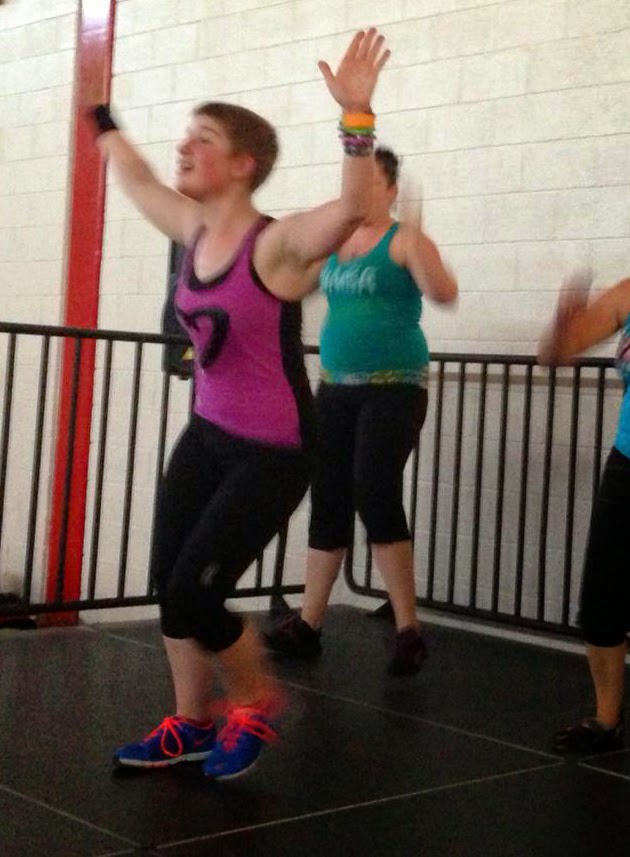
Ever since March, I was working on my biggest goal for the year: my Zumbathon for the Crohn's & Colitis Foundation of America (CCFA). A Zumbathon is a long Zumba dance party in a larger-than-usual venue, with proceeds going to charity.

I've wanted to do this for a while, but the moment that really showed me I needed to was in January, on the tail end of my Christmas flare, when I found myself alone and overwhelmed and sobbing in the backseat of my car in a hospital parking lot. I got a text message asking me to lead a Zumba class, and it calmed me down like nothing else could. Zumba has given me such joy and gotten me through the hardest times, so I thought it was only fitting to leverage the best thing in my life to fight the worst.

So much love for all who attended.
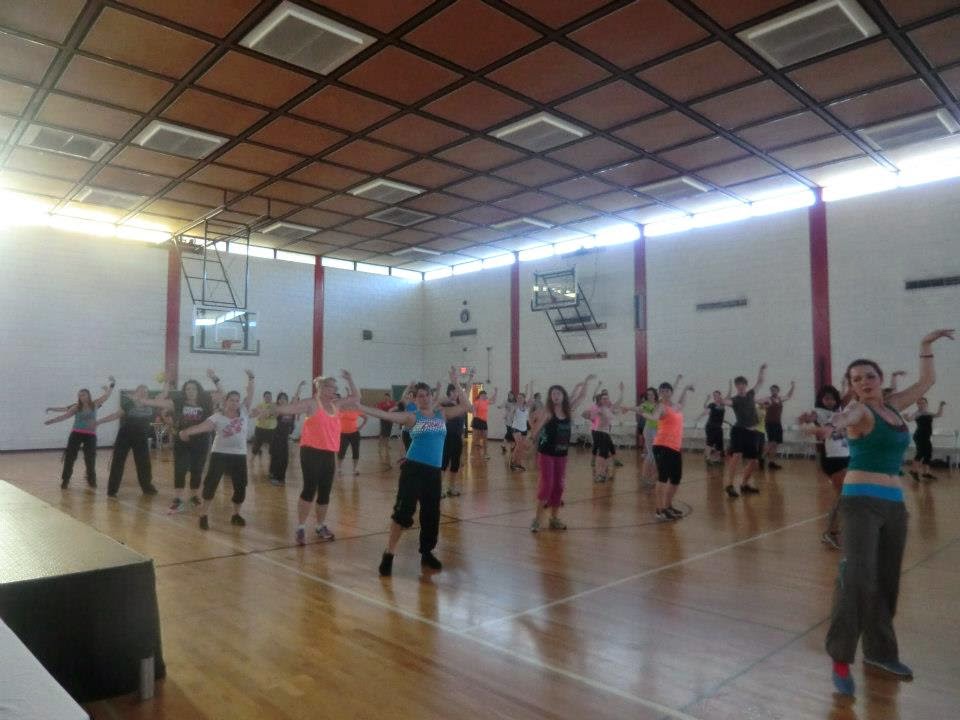
I won't go into detail about everything required to plan an event like this one, but let's just say it took two months and countless hours of effort. And it was emotionally draining to transform myself to an outspoken advocate about things that are easier not to even think about. The result was better than I could have hoped for: over 70 people in attendance, awareness raised about these diseases that can be so tough to talk about, almost $1,100 raised.

To the many people who donated, attended, and spread the word, thank you. It means more than I could possibly express. Nothing beat seeing my coworkers, my best friends, strangers, and my college professor all dancing together. Sorrow is powerful, but so are joy and community.

Filling the gym at my former university.
I have a useful but troublesome habit of pouring my entire self into the pursuit of every goal. I will accept no less than excellence and refuse to relinquish control. I'm happy that I've done so much in such a short time, but I'd be even happier if I were able to reach some sort of balance. Rather than losing things in a haze of stress, I should savor them. I should ask for help and accept it.

...I'm working on it.